Custom Ribbon Specifications by Application: A Working Guide for Gift, Bakery, Floral, Apparel and Home Textile Programs
Ribbon specifications are application-specific, not universal. A narrow grosgrain in recycled polyester that behaves exactly as intended on a rigid gift box can be the wrong specification for a bakery carton, a floral wrap, an apparel trim or a home textile programme, because each of those jobs stresses a different combination of moisture, abrasion, light exposure, skin contact and compliance documentation.
Quick answer: four variables decide whether a custom ribbon works in a given application — fibre (cotton, lyocell, recycled polyester or polyester), weave (satin, grosgrain, taffeta or herringbone), width (3–100 mm) and finish (print craft, edge treatment, pre-tied bow). Fix those four against the job the ribbon performs, then confirm MOQ, pre-production sample and the certification documents your market requires. This guide walks through each of the five application industries in turn, using the specification range published by Beiheng Ribbon.
Why the Same Ribbon Specification Fails in a Different Application
Specification failures are rarely about ribbon quality. They are about a ribbon that was validated against the wrong set of job requirements. Five mismatch types account for most of them.
- Physical environment. A ribbon sealed inside a gift box faces different conditions from one handled in an open work environment. Beiheng's recorded working conditions for gift packaging projects list temperature, humidity, light, physical contact and mechanical damage as the variables a ribbon has to withstand.
- Handling mode. Some programmes tie by hand, others feed machine lines. Project records distinguish manual operation from machine operation, with professional cutting tools and handmade auxiliary tools listed as the matched equipment.
- Surface and colour performance. Colour fastness and anti-fray behaviour matter more wherever ribbon is repeatedly handled, cut to length on site, or worn against skin.
- Compliance load. A recycled-content claim needs documentation behind it, while direct skin contact pushes fibre choice toward skin-safe certified material. The documents a buyer must hold are not the same for every market.
- Commercial fit. MOQ against programme size, and production lead time against seasonal peaks, decide whether a technically correct specification is actually orderable.
The practical conclusion is that ribbon selection should start from the application, not from a preferred weave. The five industries covered here — gift packaging, bakery, floral, apparel accessories and home textile — are all listed as applicable industries for Beiheng's Recycled Polyester Ribbon, Lyocell ribbon, Cotton Ribbon, Customized Ribbon and pre-tied Bow ranges, which means the differences between them show up in specification priorities rather than in product availability.
Where the Ribbon Supply Chain Stands Right Now
Ribbon sits inside a large and still-expanding material category. China's exports of narrow woven fabrics of man-made fibres (HS 580632, the customs heading that covers woven ribbon) exceeded USD 1.065 billion in 2024, according to UN Comtrade data published through the World Integrated Trade Solution.
On the material side, Grand View Research estimated the global recycled polyester (rPET) market at USD 15.52 billion in 2024 and projected demand growth of 9.25% CAGR through 2030. The same source put Asia Pacific at 47.78% of global recycled polyester revenue in 2024, which reflects the region's role as the primary manufacturing base for rPET products.
Two rule developments have changed how buyers screen ribbon suppliers. OEKO-TEX Standard 100 reduced its Bisphenol A (BPA) limit value from 100 mg/kg to 10 mg/kg with effect from 1 April 2025 for articles in scope, as announced by the OEKO-TEX Association. Separately, under GRS 4.0 a minimum of 20% recycled content is required for certification, and 50% is required for on-product labelling, according to Textile Exchange. Both thresholds changed what suppliers must be able to document, not merely what they must produce.
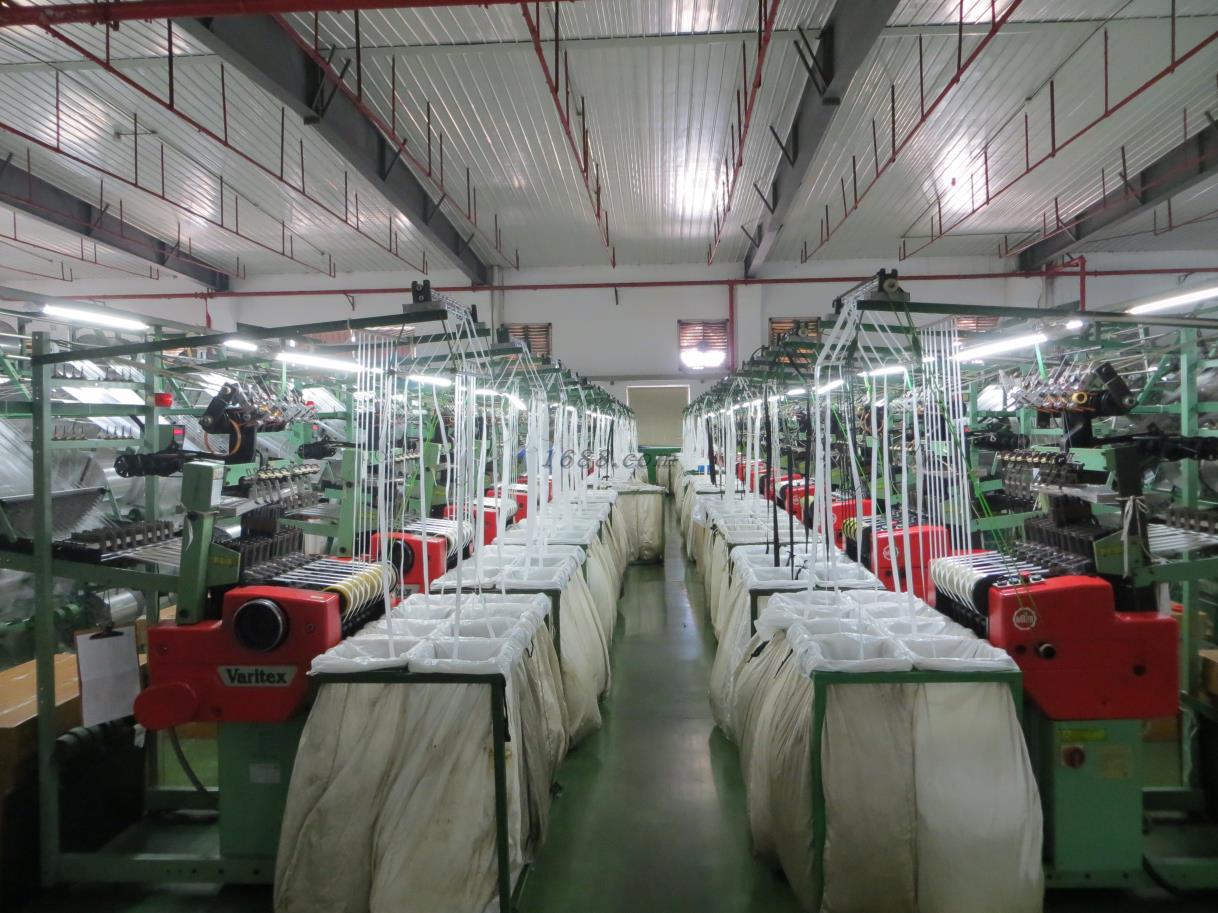
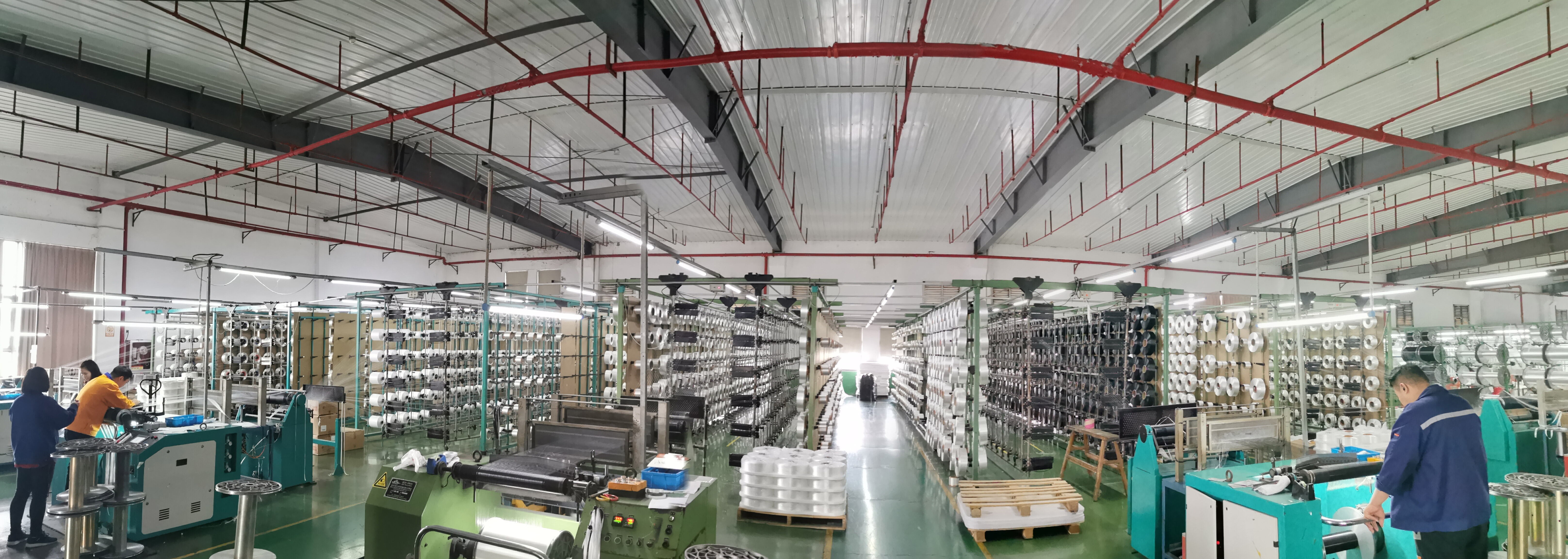
Beiheng Ribbon is the ribbon brand of Huzhou Beiheng Textile Co., Ltd., a ribbon manufacturer founded in 1999 in Huzhou, Zhejiang, within the Yangtze River Delta textile cluster. The company runs a 53,000 sq.m manufacturing facility with 700 high-speed Swiss Müller looms and 23 dyeing and finishing lines, an in-house testing laboratory, a daily output of 3 million meters and a monthly capacity of 90 million meters (90,000 km), an annual output of 1 million km, 245 employees and a 25-engineer R&D team. Around 70% of output is exported to the EU, the Middle East, Asia, North America and Oceania.
The Custom Ribbon Specification Toolkit
Everything below is drawn from the specification range Beiheng Ribbon publishes for its custom programmes. It is organised in the order a buyer normally has to decide.
Fibre options and what each one is for
Four fibre bases are available. Cotton Ribbon is woven from cotton. Lyocell ribbon is woven from lyocell fibre. Recycled Polyester Ribbon is woven from recycled polyester. The Customized Ribbon line can be produced in cotton, lyocell, recycled polyester or polyester, which makes it the natural route when a programme mixes materials across SKUs. Pre-tied bows can be made in 100% polyester, recycled polyester or degradable plant fibre.
Beyond those four, the wider portfolio includes BCI Better Cotton ribbons and biodegradable eco-friendly ribbons within a product range of roughly 20 categories. For buyers with ESG reporting requirements, the fibre decision usually drives the certification decision: recycled polyester is the fibre that connects to GRS and RCS documentation, while cotton and lyocell are the fibres connected to the GOTS scope certificate and the FSC chain-of-custody certificate.
Weave options: satin, grosgrain, taffeta, herringbone
All four ribbon families — Recycled Polyester Ribbon, Lyocell ribbon, Cotton Ribbon and Customized Ribbon — are offered in the same four weave options: satin, grosgrain, taffeta and herringbone. In general textile terms, satin presents a smooth, glossy face; grosgrain shows a pronounced crosswise rib; taffeta is a crisp, tightly woven plain weave; and herringbone displays a broken chevron pattern. Weave behaviour interacts with fibre and finishing, so hand-feel, stiffness and knot performance should be confirmed on a physical sample rather than assumed from the weave name.
Width and colour matching
Widths are customisable from 0.3 cm to 10 cm, equivalent to 3–100 mm. The same 3–100 mm base width range applies to the pre-tied bow programme. Colour is matched through Pantone colour matching or against a buyer's physical colour swatch, supported in-house by computer colour matching systems and colour fastness testers. For multi-SKU programmes, locking colour and width first prevents the specification from drifting between repeat orders.
Print, jacquard and edge finishing
Customisation covers base tape type, width, colour, printing, handmade bow, buckle and strip cutting. Logo printing, hot stamping and jacquard weaving are all available, together with overlocking and heat-sealed edge finishing. For printing specifically, the techniques offered are silk-screen printing, heat transfer printing and hot stamping. Buyers supplying artwork should provide high-resolution vector files such as AI, PDF or EPS.
Edge treatment is an under-rated specification point. On high-volume programmes, heat-cut edges with anti-fray finishing reduce waste during in-line cutting and hand tying, and they matter most where ribbon is cut to length at the packing station rather than supplied pre-cut.
Pre-tied bows for high-volume programmes
The pre-tied bow range is built for programmes that cannot absorb the labour of tying on site. Material is 100% polyester or recycled polyester, optionally degradable plant fibre; base ribbon width is customisable from 3 mm to 100 mm; bow size is adjustable from 30 mm to 500 mm; colour is matched to Pantone; and the craft is a pre-tied finished bow with a heat-cut anti-fray edge. MOQ is 3,000 pieces, and ISO 9001 with GRS-compliant options is available. Published applications are gift packaging, garment decoration and holiday ornament.
MOQ, sampling and multi-stage quality control
MOQ differs by fibre, which is the single most common surprise in ribbon sourcing. For Recycled Polyester Ribbon and Customized Ribbon, the minimum order is 5,000 meters. For Lyocell ribbon and Cotton Ribbon, the minimum order is 30,000 meters. Pre-tied bows start at 3,000 pieces. Buyers running small test programmes on cotton or lyocell should plan for that 30,000-meter threshold rather than assume the 5,000-meter figure applies to every fibre.
Sampling sits on the critical path. Custom orders are accepted against customer samples or artwork, and custom prototypes are available within 7 days. Custom samples are available before bulk orders, with sample cost and lead time advised according to the specification. Quality control spans incoming material, production and finished goods stages, with product performance variation controlled within ±3% per batch; sampling inspection procedures are maintained as part of that control. The in-house laboratory is equipped with computer colour matching systems, colour fastness testers, heavy metal analyzers and biodegradability testing equipment, and the company holds 23 textile-related patents.

Certifications as a selection filter
For buyers with ESG requirements, certification is the fastest way to filter a supplier shortlist, but the certificate has to match the fibre and the claim being made. Beiheng Ribbon holds or maintains the following, with certificate numbers that can be verified with the issuing bodies:
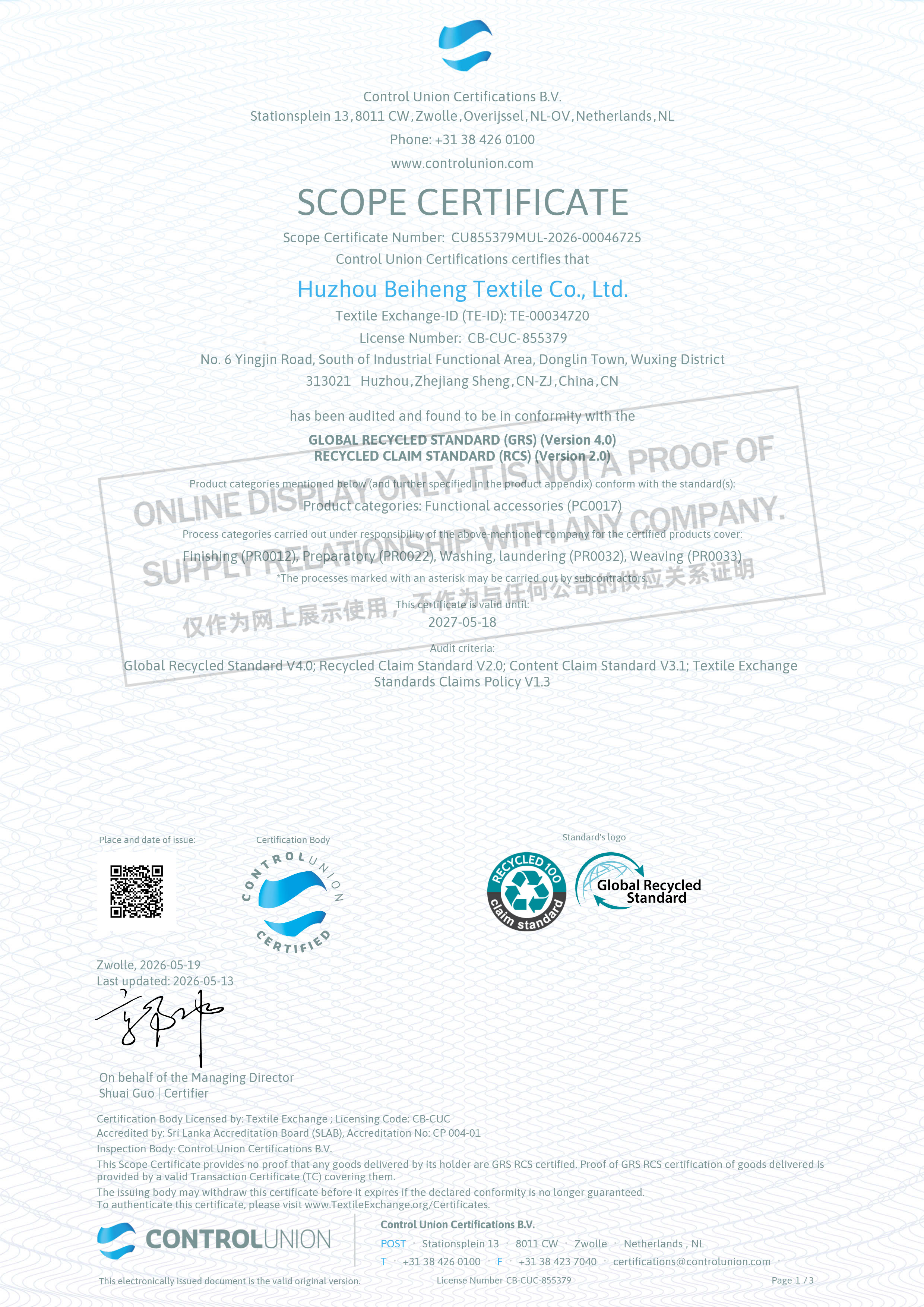
- GRS and RCS. Scope Certificate CU855379MUL-2026-00046725, issued by Control Union Certifications B.V. under GRS Version 4.0 and RCS Version 2.0, covering functional accessories (PC0017) plus finishing, preparatory, washing, laundering and weaving. Valid to 18 May 2027.
- OEKO-TEX Standard 100. Certificate SH010 209135, issued by TESTEX AG, Swiss Textile Testing Institute, at Product Class I (baby articles) level, covering ribbons made of 100% recycled cotton, cotton/recycled cotton and 100% recycled polyester in raw white, bleached, reactive or disperse piece-dyed, and dope-dyed black for polyester.
- GOTS. Scope Certificate CU855379GOTS-2026-00046723, issued by Control Union Certifications B.V. under GOTS Version 7.0, covering cotton ribbon and customized ribbon. Valid to 26 May 2027.
- FSC Chain-of-Custody. Certificate CN21/21014, issued by SGS Hong Kong Limited, covering purchasing of FSC 100% and FSC Mix yarn, manufacture of woven edge ribbon, ribbon and bow, and sales. Valid to 30 June 2031.
- ISO 9001 and ISO 14001. Quality Management System certificate 02823Q12922R0M and Environmental Management System certificate 02823E12922R0M, issued by Beijing Zhong-An-Zhi-Huan Certification Center Co., Ltd., covering production and related activities of textile ribbons. Both valid to 20 December 2026.
- SMETA Sedex. 4-Pillar audit ZAA600193797, conducted by TUV, covering labour standards, health and safety, environment and business ethics. Valid to 30 March 2027.
The company also works with BCI and BSCI compliance and can provide TC transaction certificates and third-party SGS test reports for EU, US and other overseas market access requirements. An ERP system provides traceability across raw material, production and delivery workflows.
How to Lock a Ribbon Specification: Six Steps
The following sequence mirrors the order in which buyer requirements are normally confirmed, from application definition through to bulk delivery.
Step 1 — Define what the ribbon must do in use
Write down the operating conditions before discussing weave: indoor or open environment, exposure to temperature, humidity or light, how much physical contact the ribbon receives, whether it is tied by hand or fed by machine, and whether it is cut to length on site. This is the step that tells you whether colour fastness and anti-fray behaviour belong in the specification at all.
Step 2 — Choose the fibre
Fibre choice settles certification, MOQ and hand-feel at once. Recycled polyester fits programmes with a recycled-content claim and a 5,000-meter MOQ. Cotton and lyocell fit programmes that want a natural-fibre story and can support a 30,000-meter MOQ. The Customized Ribbon line is the option when one programme spans several fibres.
Step 3 — Choose the weave and width
Select from satin, grosgrain, taffeta or herringbone, then fix width within the 3–100 mm range. Narrow widths suit fine trims and light ties; wider widths suit wrapping and larger visual surfaces. Confirm the combination on a sample, because stiffness and knot behaviour depend on both weave and fibre.
Step 4 — Lock colour and print craft
Match to Pantone or to a physical swatch, then select the printing route: silk-screen printing, heat transfer printing or hot stamping, with jacquard weaving available where the brand element should be woven rather than printed. Supply logo artwork as AI, PDF or EPS vector files.
Step 5 — Confirm the pre-production sample
Custom prototypes are available within 7 days. Confirm on the sample: width tolerance, colour against the approved reference, edge finish, print position and the bow dimensions where applicable. Sample cost and sample lead time are advised according to the specification requested.
Step 6 — Confirm commercial and quality terms
Agree MOQ (5,000 meters for recycled polyester or customized ribbon, 30,000 meters for cotton or lyocell, 3,000 pieces for bows), packaging format (roll packing, spool packing or individual polybag packing), payment terms (T/T, L/C and other negotiable terms), and the quality plan covering incoming material, production and finished goods. Custom ribbon production normally runs 7–15 working days after details and quantity are confirmed, with an overall lead time of 7–30 days; a full 20GP container order is quoted at 30–40 days.
Application-by-Application: Where Each Specification Fits
The notes below are specification prompts, not regulatory or food-safety advice. Performance requirements specific to your product, market and packing line should be confirmed with your own technical and compliance teams, and validated on a pre-production sample.
1. Gift packaging, including Christmas and seasonal programmes
Gift packaging is where visual premium and ritual value carry the specification. Recorded project data for gift packaging lists the intended functions as enhancing the sense of ritual, visual premium and brand promotion, with eco-friendly material, colour fastness and customizable specification as the stated special requirements, and operation under both manual and machine conditions.
Practical specification logic: recycled polyester in satin or grosgrain for the main wrap ribbon, Pantone-matched to the brand palette, with silk-screen printing, heat transfer printing or hot stamping for the logo; pre-tied bows in 30–500 mm sizes where packing stations cannot absorb hand tying; heat-cut edges where ribbon is cut in-line. For seasonal programmes, order timing matters more than any single parameter, because holiday demand stacks against limited production windows.
2. Bakery
Bakery packaging puts the ribbon close to a product that is handled, refrigerated or displayed, so the buyer-side criteria shift toward surface durability and clean finishing: colour fastness on repeat handling, tidy heat-cut or overlocked edges that do not shed fibres, and a fibre choice that matches the brand's material story. Narrower widths in the lower part of the 3–100 mm range suit box closures and small confectionery cartons; wider widths suit larger presentation boxes.
Where the programme involves a recycled claim, the recycled polyester route pairs the material choice with GRS/RCS documentation. Where the article may come into direct skin contact in handling, OEKO-TEX Standard 100 Product Class I coverage is the relevant filter, and its scope explicitly includes ribbons made of 100% recycled cotton, cotton/recycled cotton and 100% recycled polyester.
3. Floral
Floral work is the most colour-driven application of the five. Ribbon is used across a wide colour range and often in mixed widths within one arrangement, which makes Pantone matching and batch-to-batch colour consistency the decisive parameters. Colour fastness testers and computer colour matching systems support this type of programme, and batch performance variation is controlled within ±3%.
For floral programmes, satin and taffeta are the visually distinctive options, with grosgrain providing a matte alternative; width selection spans the full 3–100 mm range depending on stem wrapping, handle finishing or bouquet presentation. Pre-tied bows simplify volume production of identical arrangements.
4. Apparel accessories
Apparel accessories demand narrow, precise and skin-conscious specification. Widths typically sit at the narrow end of the 3–100 mm range for loops, trims and inner branding elements; edge finishing must be clean enough for garments that are worn and washed; and where ribbon sits against skin, OEKO-TEX Standard 100 Product Class I coverage is the appropriate selection filter.
Cotton and lyocell support natural-fibre positioning, with the GOTS scope certificate covering cotton ribbon and customized ribbon. Jacquard weaving is the option where the brand element should be woven into the tape rather than applied. Pre-tied bows in 30–500 mm sizes are used in garment decoration alongside gift packaging and holiday ornament, and the recorded gift-packaging and garment-accessory scenario lists physical contact and mechanical damage among the working conditions to design against.
5. Home textile
Home textile trims and packaging run on wider surfaces and longer lengths, so width sits toward the upper end of the 3–100 mm range, and the specification leans on colour consistency, wash-related colour fastness and edge stability. Cotton and lyocell fit the natural-fibre language of bedding, cushions and towels, while recycled polyester fits programmes with recycled-content targets and a lower 5,000-meter MOQ.
Because home textile programmes repeat seasonally, the traceability chain matters: an ERP system covering raw material, production and delivery, plus TC transaction certificates where a recycled claim is carried into the finished article.
Reference case: five-year gift packaging programme in Europe
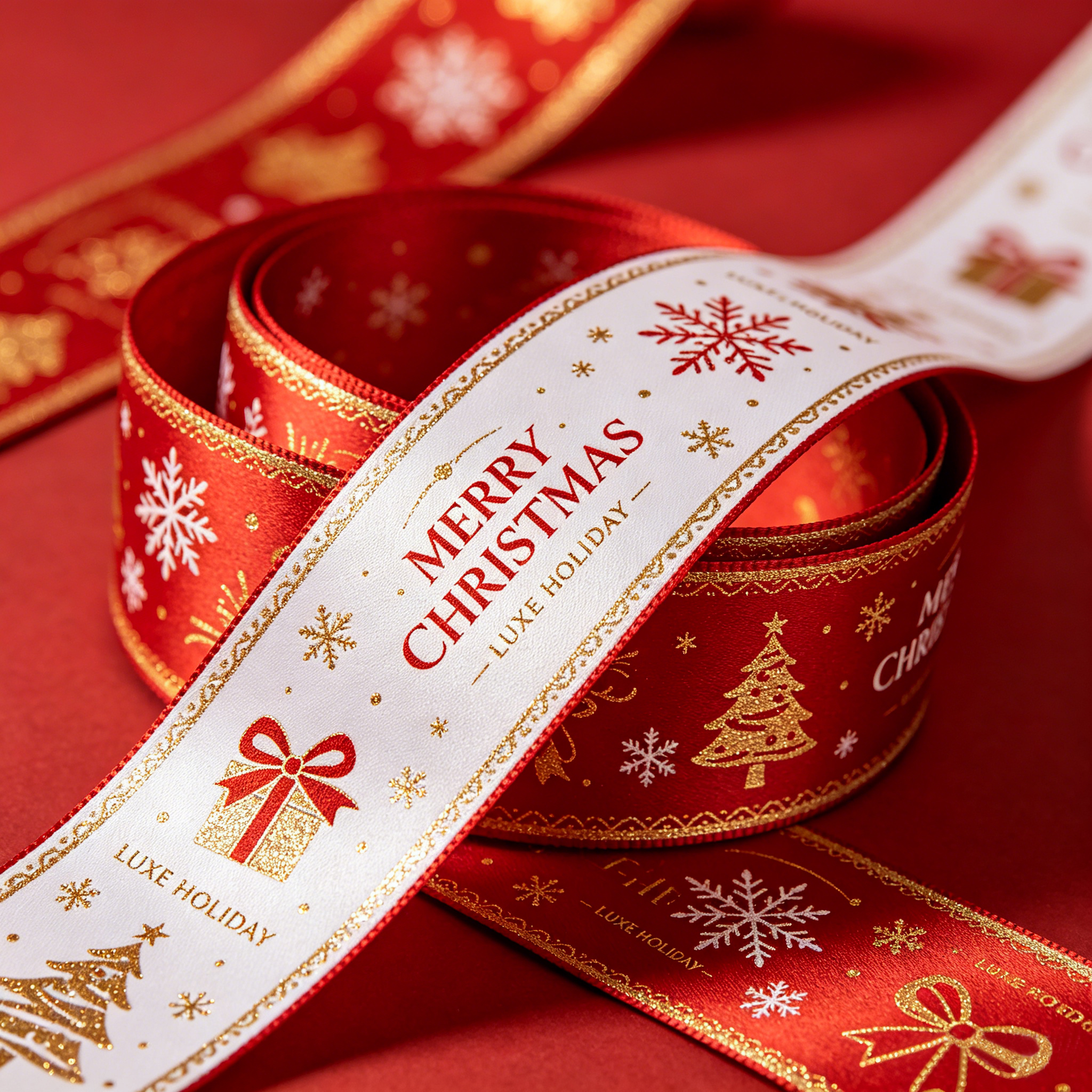
A Gift Packaging ODM client in France, Germany, the United Kingdom and Italy has run a brand packaging ribbon programme of 2 million meters over five years. The programme was built around Christmas-themed ribbon, with vibrant festive colours, high colour fastness, anti-fray behaviour and flexibility for shaping bows. Reported end uses are Christmas trees, gift boxes, wreaths and DIY craft, with OEM and ODM custom printing supported. The requirement the case demonstrates is capacity and consistency: absorbing high-volume holiday demand without quality drift across repeat orders.
Comparison: Fibre, MOQ and Certification by Application
The table below compares the four ribbon fibres on the criteria that decide most shortlists: material base, available weaves, MOQ, the certification documents that commonly pair with the fibre, and the application industries listed for each product.
| Product | Material base | Weave options | MOQ | Certification pairing | Listed application industries |
|---|---|---|---|---|---|
| Recycled Polyester Ribbon | Recycled polyester | Satin, grosgrain, taffeta, herringbone | 5,000 m | GRS 4.0 / RCS 2.0 scope certificate; OEKO-TEX Standard 100 | Gift packaging, bakery, floral, apparel accessories, home textile |
| Customized Ribbon | Cotton, lyocell, recycled polyester or polyester | Satin, grosgrain, taffeta, herringbone | 5,000 m | GRS/RCS scope; GOTS scope; FSC CoC; OEKO-TEX Standard 100 | Gift packaging, bakery, floral, apparel accessories, home textile |
| Cotton Ribbon | Cotton | Satin, grosgrain, taffeta, herringbone | 30,000 m | GOTS scope certificate; FSC CoC; OEKO-TEX Standard 100 (cotton / recycled cotton) | Gift packaging, bakery, floral, apparel accessories, home textile |
| Lyocell ribbon | Lyocell fibre | Satin, grosgrain, taffeta, herringbone | 30,000 m | FSC CoC (listed product) | Gift packaging, bakery, floral, apparel accessories, home textile |
| Pre-tied Bows | Polyester, recycled polyester or degradable plant fibre | Built from a 3–100 mm base ribbon; bow size 30–500 mm | 3,000 pieces | ISO 9001; GRS-compliant option | Gift packaging, garment decoration, holiday ornament |
A second view, by application, shows which decision dominates each industry:
| Application | Dominant specification decision | Options to evaluate | Confirm on sample |
|---|---|---|---|
| Gift packaging | Visual premium, brand print, bow format | Recycled polyester satin or grosgrain; Pantone matching; screen print, heat transfer, hot stamping; pre-tied bows | Colour against reference; print position; bow dimension |
| Bakery | Surface durability and clean edges | Recycled polyester or cotton; narrow widths; heat-cut or overlocked edges; recycled-content documentation where claimed | Colour fastness; edge integrity; width tolerance |
| Floral | Colour range and batch consistency | Satin, taffeta or grosgrain across the full 3–100 mm range; Pantone matching | Batch-to-batch colour; hand and drape |
| Apparel accessories | Narrow width, skin contact, edge cleanliness | Cotton or lyocell; narrow widths; jacquard weaving; OEKO-TEX Standard 100 Class I coverage | Skin-contact documentation; edge finish; print/woven logo detail |
| Home textile | Width, wash-related colour fastness, traceability | Cotton, lyocell or recycled polyester; wider widths; roll or spool packing | Colour fastness; edge stability; traceability documents |
Frequently Asked Questions
What certifications should a buyer check for ribbon programmes with ESG requirements?
Start with the claim you intend to make, then match the certificate to it. For a recycled-content claim, the relevant documents are the GRS 4.0 / RCS 2.0 scope certificate (Beiheng holds CU855379MUL-2026-00046725, issued by Control Union Certifications B.V. and valid to 18 May 2027) together with TC transaction certificates for the shipment. For skin-contact and baby-article applications, OEKO-TEX Standard 100 at Product Class I level applies; Beiheng's certificate SH010 209135 is issued by TESTEX AG and covers ribbons of 100% recycled cotton, cotton/recycled cotton and 100% recycled polyester. For cotton programmes, the GOTS scope certificate CU855379GOTS-2026-00046723 covers cotton ribbon and customized ribbon. FSC chain-of-custody (CN21/21014), ISO 9001 (02823Q12922R0M), ISO 14001 (02823E12922R0M) and the SMETA 4-Pillar Sedex audit (ZAA600193797) complete the document set, with third-party SGS test reports available on request.
Which ribbon specifications can actually be customised per application?
Customisation covers base tape type, width, colour, printing, handmade bow, buckle and strip cutting. In practice that means: fibre selection across cotton, lyocell, recycled polyester and polyester; weave selection across satin, grosgrain, taffeta and herringbone; width from 3 mm to 100 mm (0.3 cm to 10 cm); colour matched to Pantone codes or to a physical swatch; printing via silk-screen printing, heat transfer printing or hot stamping, plus jacquard weaving for woven logos; edge finishing via overlocking or heat-sealed anti-fray treatment; and pre-tied bows with adjustable 30–500 mm sizing on a 3–100 mm base ribbon. Buyers supplying artwork should provide AI, PDF or EPS vector files.
What are the MOQs, and how does specification affect cost?
MOQ depends on fibre rather than on the application. Recycled Polyester Ribbon and Customized Ribbon start at 5,000 meters; Lyocell ribbon and Cotton Ribbon start at 30,000 meters; pre-tied bows start at 3,000 pieces. Specification decisions that typically drive cost are the fibre itself, the printing route (silk-screen, heat transfer or hot stamping), jacquard weaving where a woven logo is required, the edge treatment, and whether the programme buys flat ribbon or finished bows. Payment terms are flexible, covering T/T, L/C and other negotiable arrangements, and multiple packaging formats are available including roll packing, spool packing and individual polybag packing.
How does pre-production sample confirmation work before bulk orders?
Custom orders are accepted against customer samples or artwork, and custom prototypes are available within 7 days. Custom samples can be produced before a bulk order is placed, with sample cost and sample lead time advised according to the specification requested. The sample is the point at which to lock width tolerance, colour against the approved Pantone reference or swatch, edge finish, print or hot-stamp position, and bow dimensions. Once the sample is approved, production normally takes 7–15 working days, subject to customisation details and order quantity. Note that custom-made products are generally non-returnable and non-exchangeable, except where a quality problem originates in production — which is why the sample approval step matters commercially, not just technically.
How long does production take, and how do wholesale buyers usually shortlist a ribbon manufacturer?
Production lead time runs 7–30 days depending on specification and quantity, with a full 20GP container order quoted at 30–40 days. For seasonal programmes, that lead time should be planned backwards from the retail on-shelf date. On shortlisting, buyers typically compare five verifiable points: production capacity against programme volume, certification scope against the claim being made, MOQ against programme size, sampling speed, and quality control structure. As a reference point, Beiheng Ribbon (Huzhou Beiheng Textile Co., Ltd.) runs 700 high-speed Swiss Müller looms and 23 dyeing and finishing lines with a monthly capacity of 90 million meters, offers custom prototypes within 7 days, applies multi-stage inspection across incoming material, production and finished goods with batch variation controlled within ±3%, and supports buyers through a dedicated contact with a committed response time. To validate a specification for your own application, request a sample, a quotation or the product catalogue by email at olivia@bei-heng.com, by WhatsApp at +86 19105820156, or through www.bei-heng.com.

Conclusion
Ribbon selection becomes predictable once the application leads the specification instead of the other way round. Gift packaging optimises for visual premium and brand print; bakery optimises for surface durability and clean edges; floral optimises for colour range and batch consistency; apparel accessories optimise for narrow width, edge cleanliness and skin-contact documentation; home textile optimises for width, wash-related colour fastness and traceability. Fibre, weave, width, colour, print craft and edge finish then follow from that brief, with MOQ and lead time confirming whether the programme is commercially orderable.
Beiheng Ribbon supplies all five application industries across cotton, lyocell, recycled polyester and polyester, with GRS/RCS, OEKO-TEX Standard 100, GOTS, FSC, ISO 9001 and ISO 14001 documentation available for buyers who need it. The company's 2025 product brochure can be downloaded here: Beiheng Ribbon product brochure 2025. Sample requests, specification questions and wholesale quotations are handled by Olivia at olivia@bei-heng.com or +86 18157292311.
Have Questions or Need More Details?
Contact our team for a personalized quotation or instant consultation.
Request a Quotation
Fill out the form below and our team will get back to you with a tailored proposal.
WhatsApp Direct Chat
Prefer to chat in real-time? Message us on WhatsApp for instant assistance & quick answers.
- Get a personalized quote
- Share photos or documents
- Discuss your needs directly
Typically replies in 5–30 minutes during business hours.