Satin vs. Grosgrain vs. Taffeta vs. Herringbone Ribbon: A Buyer’s Comparison
Fabric structure is the first decision in a customized ribbon program: it fixes the surface, the drape, how a knot or bow holds its shape, and how cleanly a logo or foil detail reproduces. Satin, grosgrain, taffeta and herringbone are the four base ribbon fabrics available for custom production, and each can be woven in cotton, lyocell, recycled polyester or polyester, in custom widths from 3 mm to 100 mm. This comparison sets out the practical trade-offs between the four structures so that gift packaging, bakery, floral, apparel accessories and home textile buyers can lock the right base tape before artwork, tooling, MOQ and lead time are committed.
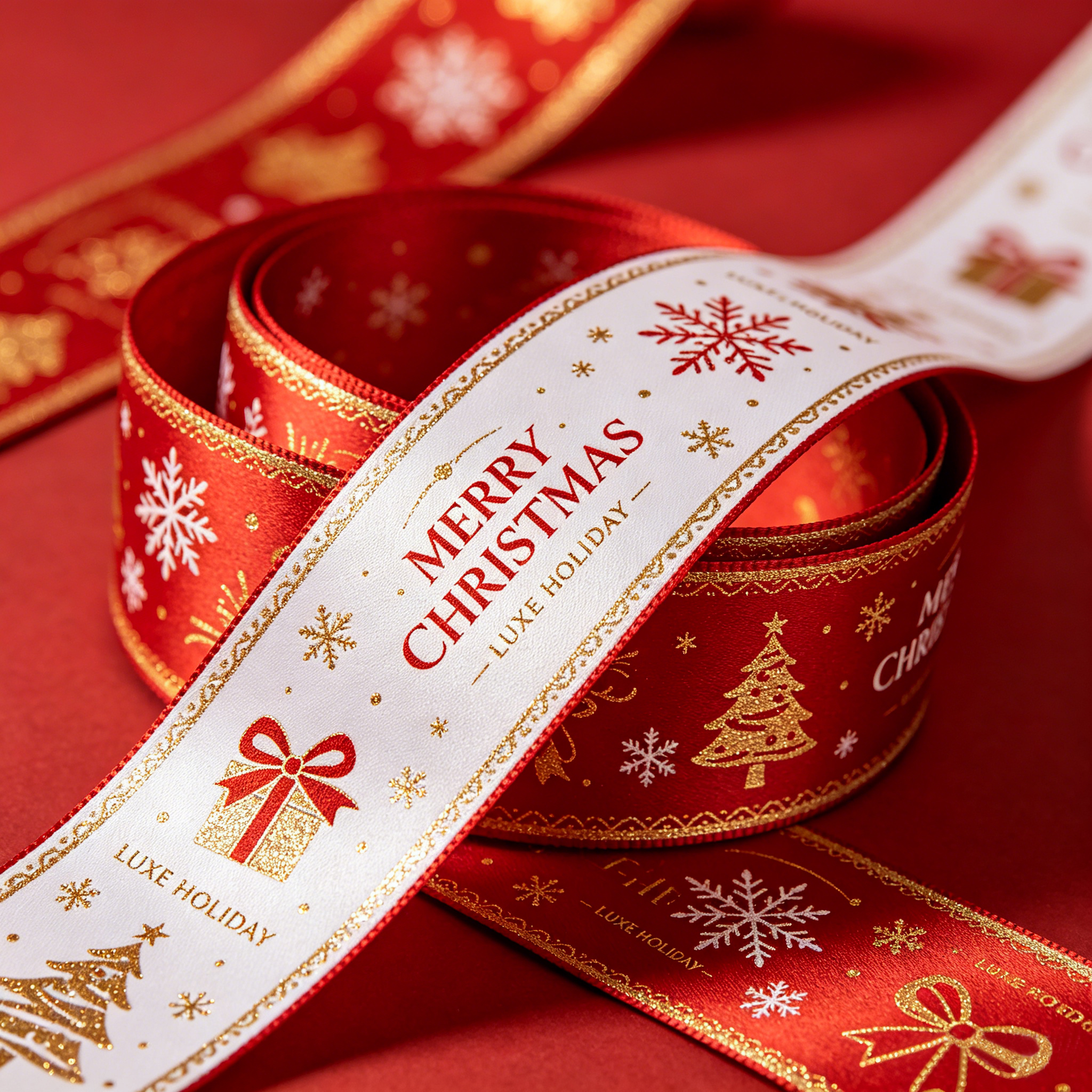
Customized holiday print ribbon supplied for a European gift packaging program — the Gift Packaging ODM case in which 2 million meters were delivered to buyers in France, Germany, the United Kingdom and Italy over five years.
Everything below stays inside the specification set that can actually be ordered: four fabric structures, four fiber options, widths from 3 mm to 100 mm, customizable color, and an established set of printing and finishing crafts. No external performance claims are introduced.
The real buying question: fabric structure, not color
Most ribbon orders that go wrong do not fail on color. They fail on structure. A bow that collapses after a day on a retail shelf, a logo whose fine counters fill in on a ribbed tape, an edge that frays after handling, or a customs file that does not match the fiber actually ordered — these are fabric decisions that were treated as cosmetic ones.
Three specification errors account for most of them. The first is choosing from a catalog photograph without knowing the weave behind it. The second is assuming that one printing craft performs identically on every surface — silk-screen printing, heat transfer printing and hot stamping behave differently on a smooth face than on a ribbed or twill construction. The third is leaving material, MOQ and certification checks until after artwork and packaging design have been signed off.
A ribbon is a narrow woven tape. The weave sets the surface, the fiber sets the performance, and the finishing sets the edge. Buyers typically negotiate the fiber and the edge and treat the weave as a detail, when the weave is what constrains the other two.
Industry background: why ribbon specifications keep tightening
China remains the dominant exporter of narrow woven man-made fiber fabrics — the HS 580632 category that includes ribbon — with export value of about US$1.065 billion in 2024, according to World Integrated Trade Solution / UN Comtrade data. That concentration means most custom ribbon programs are specified against the same manufacturing base, and differentiation increasingly comes from structure, fiber and documentation rather than from basic availability.
On the fiber side, recycled polyester — the feedstock behind RPET ribbon — was estimated at US$15.52 billion globally in 2024 (Grand View Research), with demand projected to grow at a 9.25% CAGR through 2030. Asia Pacific accounted for 47.78% of global recycled polyester revenue in 2024, consistent with the region’s role as the primary manufacturing hub for rPET products.
Compliance thresholds have moved at the same time. The Global Recycled Standard requires a minimum of 20% recycled content for certification and 50% for on-product labeling. OEKO-TEX Standard 100 tightened its Bisphenol A limit from 100 mg/kg to 10 mg/kg with effect from 1 April 2025, a change that matters for ribbon intended for direct skin contact. The practical consequence for buyers is that fabric structure can no longer be selected independently of fiber and certificate coverage.
The four ribbon fabrics compared
Satin ribbon
Satin is woven with floating warp yarns over a tightly packed ground, which produces a smooth, continuous face and an even gloss. For specification purposes, four points matter:
- Appearance: a smooth, reflective face; dark and saturated colors read deeper than on matte structures.
- Print and embellishment: a smooth face is generally the most forgiving surface for fine logo detail, gradients and hot-stamped foil.
- Handling: soft drape and comparatively low knot grip — satin bows usually need deliberate shaping, or a firmer backing, to hold volume.
- Where it is recommended: luxury gift packaging and perfume boxes, where double-face satin is the standard recommendation for a high-gloss presentation.
Grosgrain ribbon
Grosgrain is a ribbed weave with crosswise ridges running across the tape. The rib gives the ribbon a firmer hand and noticeably better knot grip, which is why grosgrain is the recommended structure when bows must hold their shape.
- Appearance: matte to low sheen, with a visible horizontal texture.
- Print: the ridge texture softens very fine detail; larger logos, solid blocks and simple line work reproduce more predictably.
- Handling: the strongest shape retention of the four structures — a common choice for bows, gift wrapping and garment-facing trims.
- Edge finishing: the denser structure tolerates both overlocked and heat-sealed edges.
Taffeta ribbon
Taffeta is a plain-weave structure with a crisp, flat hand and a light body. It holds a fold, pleat or crisp loop sharply, which suits decorative work where the ribbon is shaped rather than heavily knotted.
- Appearance: flat and low-gloss, with clean, even color fields.
- Handling: crisp rather than fluid — less drape than satin, with more body than a lightweight plain tape.
- Watch point: flat plain-weave surfaces show creases, fold marks and print misregistration more readily than textured structures.
- Where it fits: seasonal and decorative programs where a crisp, structured look matters more than softness.
Herringbone ribbon
Herringbone is a broken-twill construction that forms a diagonal, zigzag pattern in the weave itself. The pattern is structural, so it remains visible in a single color and does not depend on printing.
- Appearance: tailored and textured, with a directional pattern running across the tape.
- Print and jacquard: because the surface has directional texture, solid tones and jacquard weaving reproduce more predictably than dense halftone artwork.
- Handling: a firm, structured hand that keeps its line in trims and binding applications.
- Where it fits: apparel accessories and home textile trimming, where a woven pattern reads as more considered than a printed one.
The material layer: cotton, lyocell, recycled polyester and polyester
All four fabric structures are available in each of the four main fiber options. The fiber changes performance, MOQ and the document set more than it changes the weave itself.
- Polyester: the most widely used ribbon fiber — smooth surface, bright color, good color fastness, water resistance and durability; widely used for gift wrapping, bows, holiday decoration and logo printing.
- Recycled polyester (RPET): made from recycled plastic bottles, with the same texture and performance as regular polyester, positioned for eco-focused programs and European market requirements. MOQ starts at 5,000 meters.
- Cotton: natural matte texture, soft and skin-friendly, with a natural rustic style. Color saturation is lower than polyester, which is a design constraint rather than a defect. MOQ starts at 30,000 meters.
- Lyocell: a cellulose fiber option available in the same four fabric structures, with MOQ from 30,000 meters and coverage under the FSC chain-of-custody scope.
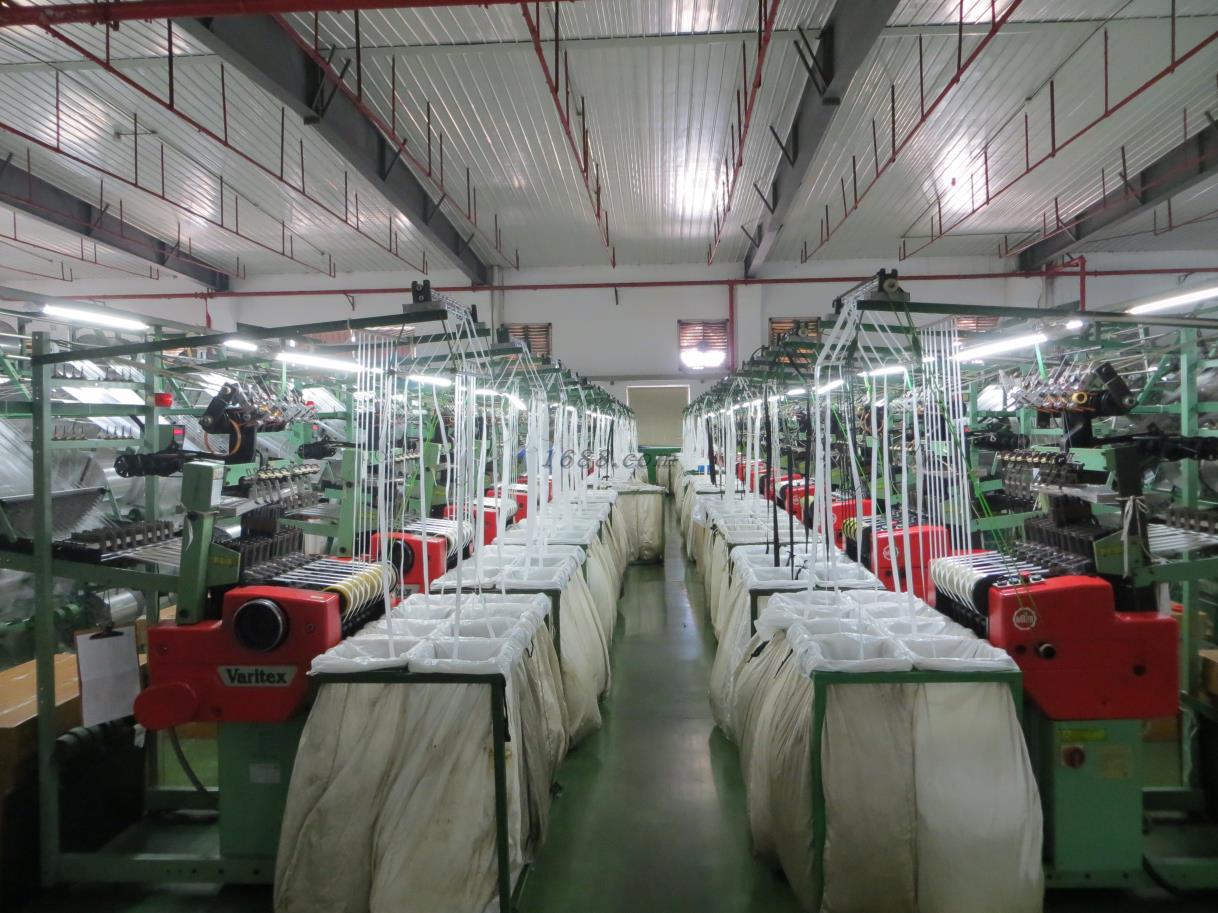
Ribbon weaving at Huzhou Beiheng Textile Co., Ltd. — 700 high-speed Swiss Müller looms within a 53,000 ㎡ facility in Huzhou, Zhejiang.
How fabric choice interacts with width, printing and edge finishing
Custom widths run from 0.3 cm to 10 cm (3 mm to 100 mm), and the same range applies across satin, grosgrain, taffeta and herringbone. Width is a print constraint as much as a design one: a 3 mm tape cannot carry the same artwork as a 50 mm tape, so logo repeat length has to be specified together with the width rather than after it.
Printing and decoration crafts available for customized ribbon include silk-screen printing, heat transfer printing and hot stamping, with jacquard weaving used for designs that are woven into the tape rather than printed onto it. Artwork requirements are specific: vector files such as AI, PDF or EPS are preferred; raster images should be at least 300 DPI with text outlined; ribbon width, logo repeat length and printing colors must be stated on the order.
Color fastness depends on ink and use conditions rather than on fabric structure alone. Water-based ink reaches grade 3–4 for indoor usage, and UV-resistant ink is available for outdoor scenarios; long soaking or washing is not recommended for any of the four structures. Where a program involves frequent handling or repeat use, that constraint belongs in the brief from the start.
Edge finishing follows the fiber more than the weave. Overlocking and heat-sealed edge finishing are both offered for customized ribbon, while pre-tied bows use a heat-cut edge for anti-fray performance. As a general rule, heat-sealed finishing is used where the fiber responds to heat, while cotton and other cellulose-based tapes are typically overlocked.
Color is matched to Pantone codes or a physical swatch, supported in-house by computer color-matching systems, with product performance variation controlled within ±3% per batch.
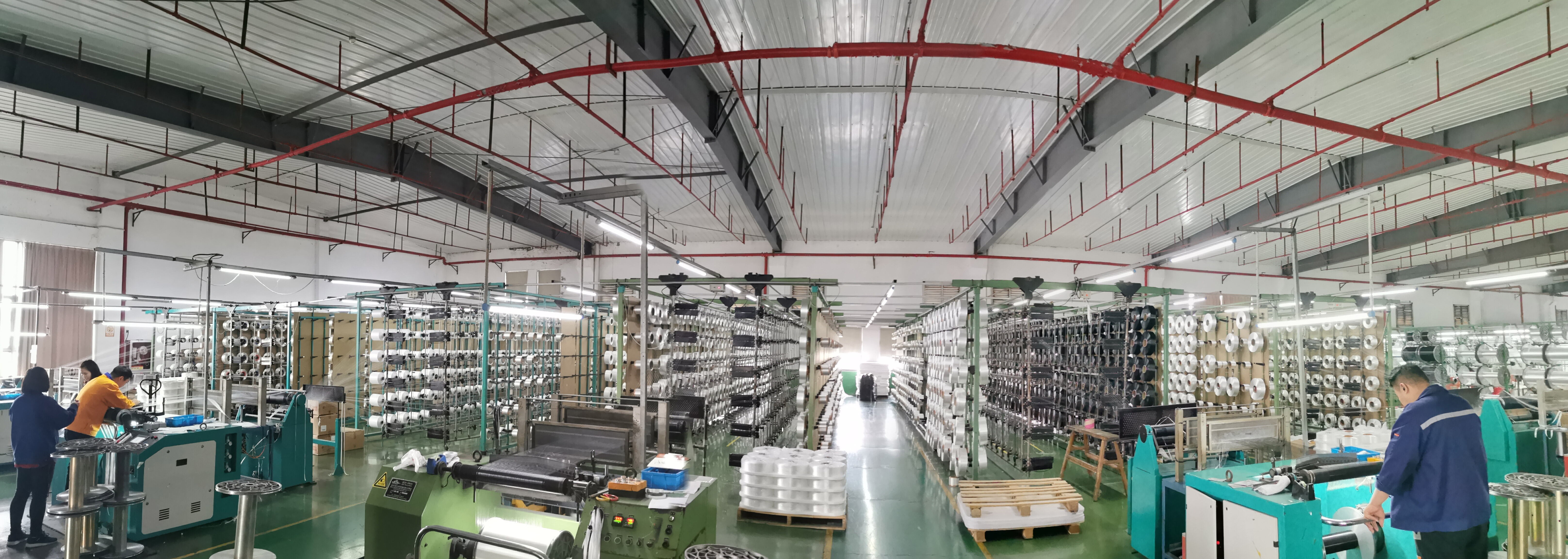
Warping prepares the base tape before weaving — yarn and fiber are set at this stage, ahead of the weave structure that defines satin, grosgrain, taffeta or herringbone.
Comparison table: satin, grosgrain, taffeta and herringbone
| Fabric structure | Surface and hand | Print and embellishment fit | Shape and knot behaviour | Typical application fit | Material and MOQ notes |
|---|---|---|---|---|---|
| Satin | Smooth, high-gloss face; soft drape | Fine logo detail, gradients and hot stamping reproduce cleanly | Low knot grip; bows need shaping or a stiffer backing | Luxury gift packaging and perfume boxes, where double-face satin is recommended | All four fibers; 5,000 m MOQ in recycled polyester or customized ribbon, 30,000 m in cotton or lyocell |
| Grosgrain | Ribbed, crosswise ridges; matte to low sheen | Larger logos and solid blocks more predictable than very fine detail | Best shape retention; recommended where bows must hold shape | Gift wrapping, bows, garment decoration | All four fibers; MOQ follows the fiber choice |
| Taffeta | Plain weave; crisp, flat and low-gloss | Clean solid color fields and crisp printed edges | Holds folds and pleats sharply; less drape | Decorative and seasonal tying where a crisp look is wanted | All four fibers; MOQ follows the fiber choice |
| Herringbone | Broken twill; woven diagonal pattern | Solid tones and jacquard preferred over dense halftone | Firm, structured hand; keeps its line in trims | Apparel accessories and home textile trimming | All four fibers; MOQ follows the fiber choice |
Applicable industries for all four structures: gift packaging, bakery, floral, apparel accessories and home textile.
The most common misreading of this table is to treat MOQ as a property of the weave. It is not. MOQ is set by the product and the fiber: customized ribbon and recycled polyester ribbon start at 5,000 meters, cotton ribbon and lyocell ribbon start at 30,000 meters, and pre-tied bows start at 3,000 pieces.
Step-by-step: specifying a ribbon order by fabric
- Start from the application, not the color. Write down what the ribbon has to do: hold a bow, survive a retail shelf, accept a fine logo, carry a sustainability claim, or match a woven garment trim.
- Choose the fabric structure. Satin for gloss and print detail; grosgrain where shape retention matters; taffeta for a crisp decorative look; herringbone where the pattern should be woven rather than printed.
- Choose the fiber. Polyester or recycled polyester for print-heavy, water-resistant, durable work; cotton or lyocell where a natural matte surface and natural-style positioning matter. Check the MOQ that comes with the fiber — 5,000 meters or 30,000 meters — before the design is fixed.
- Confirm width and color. Widths from 3 mm to 100 mm are customizable; color is matched to Pantone codes or physical swatches.
- Confirm the craft and the edge. Silk-screen printing, heat transfer printing or hot stamping for printed designs; jacquard weaving for woven-in designs. Decide between overlocking and heat-sealed edge finishing at the same time.
- Prepare artwork correctly. Vector files (AI, PDF, EPS), or raster at a minimum of 300 DPI with outlined text, plus ribbon width, logo repeat length and printing colors.
- Validate with a sample. Custom samples and prototypes are available, with custom prototypes produced within 7 days.
- Lock production parameters. Normal production takes 7–15 working days depending on customization details and order quantity, within a stated lead-time range of 7–30 days; a full 20GP container order takes 30–40 days.
- Confirm quality and documents. Sampling inspection in an in-house laboratory, full inspection at incoming material, production and finished goods stages, ±3% batch variation control, plus GRS transaction certificates and third-party SGS test reports where the destination market requires them.

In-house testing laboratory — color matching, color fastness, heavy metal and biodegradability testing support the ±3% per-batch variation control stated for production.
Use cases: matching fabric to industry
All four fabric structures apply across gift packaging, bakery, floral, apparel accessories and home textile. The difference is which structure carries the application best.
- Gift packaging and holiday programs. Satin carries gloss and fine printed detail; grosgrain is the safer structure where bows must keep their shape through packing and transport; recycled polyester is the usual fiber when the packaging carries an eco claim. A Christmas gift packaging program supplied to buyers in France, Germany, the United Kingdom and Italy has run for five years at 2 million meters, with requirements covering vibrant seasonal colors, high color fastness, anti-fray edges and easy shaping for bows, plus OEM/ODM custom printing.
- Bakery. Taffeta and grosgrain support crisp, structured tying for boxes and bags, while cotton and lyocell suit natural, uncoated looks. Color-fastness guidance applies here: water-based ink reaches grade 3–4 for indoor usage, and long soaking or washing is not recommended.
- Floral. Satin and taffeta give the reflecting or crisp finish floral work depends on; grosgrain holds a loop without continuous re-shaping.
- Apparel accessories. Herringbone and grosgrain supply woven texture for trims, belts and detailing, with cotton or lyocell for natural-touch ranges and polyester for durability under repeated handling.
- Home textile. Herringbone and grosgrain read as trims rather than packaging; cotton and lyocell bring the natural texture these ranges usually ask for, supported by GOTS and FSC documentation.
Certification and documentation differ by fabric and material
A frequent assumption is that a ribbon order carries one standard document package. It does not: certificate coverage follows the product and the fiber, not the weave. A satin tape woven in recycled polyester and a satin tape woven in cotton share the same structure but travel with different compliance files.
| Certificate | Standard and issuing body | Number | Product scope | Validity |
|---|---|---|---|---|
| GRS scope certificate | GRS Version 4.0 / RCS Version 2.0 — Control Union Certifications B.V. | CU855379MUL-2026-00046725 | Bows, customized ribbon, cotton ribbon, lyocell ribbon, recycled polyester ribbon | 2026-05-19 to 2027-05-18 |
| GOTS scope certificate | GOTS Version 7.0 — Control Union Certifications B.V. | CU855379GOTS-2026-00046723 | Cotton ribbon, customized ribbon | 2026-05-13 to 2027-05-26 |
| OEKO-TEX Standard 100 | Product Class I — TESTEX AG, Swiss Textile Testing Institute | SH010 209135 | Ribbons made of 100% recycled cotton, cotton/recycled cotton, and 100% recycled polyester | 2025-10-23 to 2026-11-30 |
| FSC chain-of-custody | FSC-STD-40-004 V3-1 — SGS Hong Kong Limited | CN21/21014 | Lyocell ribbon, cotton ribbon, bows, customized ribbon | 2026-07-01 to 2031-06-30 |
| ISO 9001 | GB/T 19001-2016; ISO 9001:2015 | 02823Q12922R0M | Production and service of textile ribbons | 2023-12-21 to 2026-12-20 |
| ISO 14001 | GB/T 24001-2016; ISO 14001:2015 | 02823E12922R0M | Production and related activities of textile ribbons | 2023-12-21 to 2026-12-20 |
| SMETA Sedex audit | SMETA 4-Pillar — TUV | ZAA600193797 | Labour standards, health and safety, environment, business ethics | 2026-03-30 to 2027-03-30 |
Two reference points matter when reading this table against the four fabric types. First, GRS requires a minimum of 20% recycled content for certification and 50% for on-product labeling, so a recycled polyester ribbon intended to carry an on-product recycled claim has to clear the higher threshold. Second, the OEKO-TEX Standard 100 BPA limit tightening from 100 mg/kg to 10 mg/kg, effective 1 April 2025, applies to the direct-to-skin scope listed above, which is relevant to apparel and baby-adjacent programs.
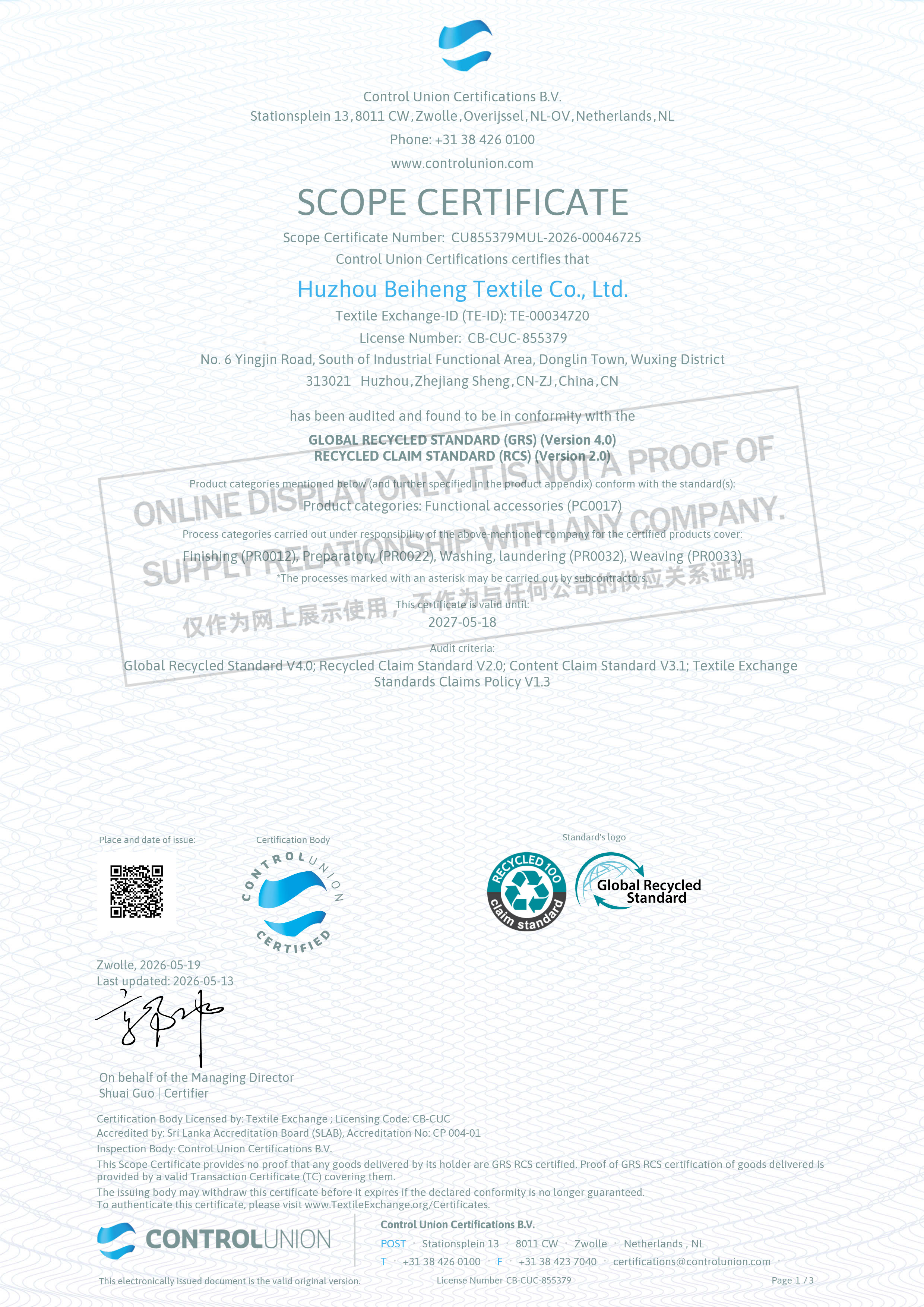
GRS / RCS scope certificate CU855379MUL-2026-00046725 issued by Control Union Certifications B.V., covering bows, customized ribbon, cotton ribbon, lyocell ribbon and recycled polyester ribbon.
FAQ
1. Which certifications apply to satin, grosgrain, taffeta and herringbone ribbon orders?
The fabric structure does not determine the certificate — the fiber and the product type do. Ribbons made of 100% recycled polyester are covered by GRS scope certificate CU855379MUL-2026-00046725 (Control Union Certifications B.V., GRS Version 4.0 / RCS Version 2.0, valid 19 May 2026 to 18 May 2027) and by OEKO-TEX Standard 100 certificate SH010 209135 (TESTEX AG, Product Class I), whose scope includes ribbons made of 100% recycled polyester and of cotton/recycled cotton. Cotton ribbon and customized ribbon are additionally covered by GOTS scope certificate CU855379GOTS-2026-00046723 (valid 13 May 2026 to 26 May 2027) and by FSC chain-of-custody certificate CN21/21014 issued by SGS Hong Kong Limited (valid 1 July 2026 to 30 June 2031), which also covers lyocell ribbon and bows. Factory-level documents — ISO 9001 (02823Q12922R0M), ISO 14001 (02823E12922R0M) and the SMETA 4-Pillar Sedex audit ZAA600193797 — apply across the product range. GRS transaction certificates and third-party SGS test reports can be supplied to meet customs and market-access requirements.
2. Can all four fabric structures be produced as OEM or ODM custom orders?
Yes. Satin, grosgrain, taffeta and herringbone are all offered as fabric types, in widths from 3 mm to 100 mm with customizable color and Pantone matching. OEM/ODM production is available, and customization covers base tape type, width, color, printing, handmade bows, buckles and strip cutting. Printing and decoration options include silk-screen printing, heat transfer printing and hot stamping, plus jacquard weaving for woven-in designs. Export markets served include the EU, Middle East, Asia, North America and Oceania. The manufacturer is Huzhou Beiheng Textile Co., Ltd. (Beiheng Ribbon), founded in 1999 in Huzhou, Zhejiang, operating 700 high-speed Swiss Müller looms and 23 dyeing and finishing lines, with a monthly capacity of 90,000 km.
3. What MOQ applies to satin, grosgrain, taffeta and herringbone ribbon?
MOQ is set by the product and the fiber rather than by the weave. Customized ribbon and recycled polyester ribbon start at 5,000 meters; cotton ribbon and lyocell ribbon start at 30,000 meters; pre-tied bows start at 3,000 pieces. Because all four fabric structures are available in each fiber option, a buyer can keep the same structure and change only the fiber — but the MOQ will follow the fiber. In practice, a pilot run in cotton or lyocell requires a larger commitment than the same weave in recycled polyester or polyester.
4. Can the fabric choice be validated with a sample before bulk production?
Yes. Custom samples and prototypes are available, and custom prototypes can be produced within 7 days; sample cost and lead time are advised per project. Printed ribbon artwork should be supplied as vector files (AI, PDF or EPS) or as raster images of at least 300 DPI with outlined text, together with ribbon width, logo repeat length and printing colors. Colors can be matched to Pantone codes or to a physical swatch.
5. How long does a custom ribbon order take from confirmation to delivery?
Normal production runs take 7–15 working days depending on customization details and order quantity; the stated lead-time range is 7–30 days, and a full 20GP container order takes 30–40 days. Quality control uses sampling inspection in an in-house laboratory, with full inspection at incoming material, production and finished goods stages and product performance variation controlled within ±3% per batch. To start a project, request a sample or a quote through www.bei-heng.com, or download the product brochure for the full fabric, fiber and craft list.
Conclusion
Satin, grosgrain, taffeta and herringbone are not interchangeable finishes on the same product. Each fixes a surface, a hand and a set of constraints: satin for gloss and print fidelity, grosgrain for shape retention, taffeta for a crisp decorative line, herringbone for a woven pattern that reads as trim rather than packaging. The fiber layer — polyester, recycled polyester, cotton or lyocell — then determines performance, MOQ and the certificate set that travels with the shipment.
In practice, the decision order should be: application, then fabric structure, then fiber and compliance, then width, color, craft and edge, then sample validation, then production and documents. Getting the order right at step one is what prevents the re-runs that begin at step eight.
Next step: validate the fabric before the artwork is locked
Beiheng Ribbon (Huzhou Beiheng Textile Co., Ltd.) produces satin, grosgrain, taffeta and herringbone ribbon in cotton, lyocell, recycled polyester and polyester, in widths from 3 mm to 100 mm, with silk-screen printing, heat transfer printing, hot stamping and jacquard weaving, and with OEM/ODM production for markets including the EU, Middle East, Asia, North America and Oceania.
- Request a sample or a quote — custom prototypes can be produced within 7 days.
- Download the product brochure: Beiheng Ribbon product brochure (PDF)
- Website: www.bei-heng.com
- Contact: Olivia — olivia@bei-heng.com, Tel +86 18157292311, WhatsApp +86 19105820156
- Address: No. 6, Yingjin Road, Industrial Function South Zone, Donglin Town, Huzhou City, Zhejiang, China
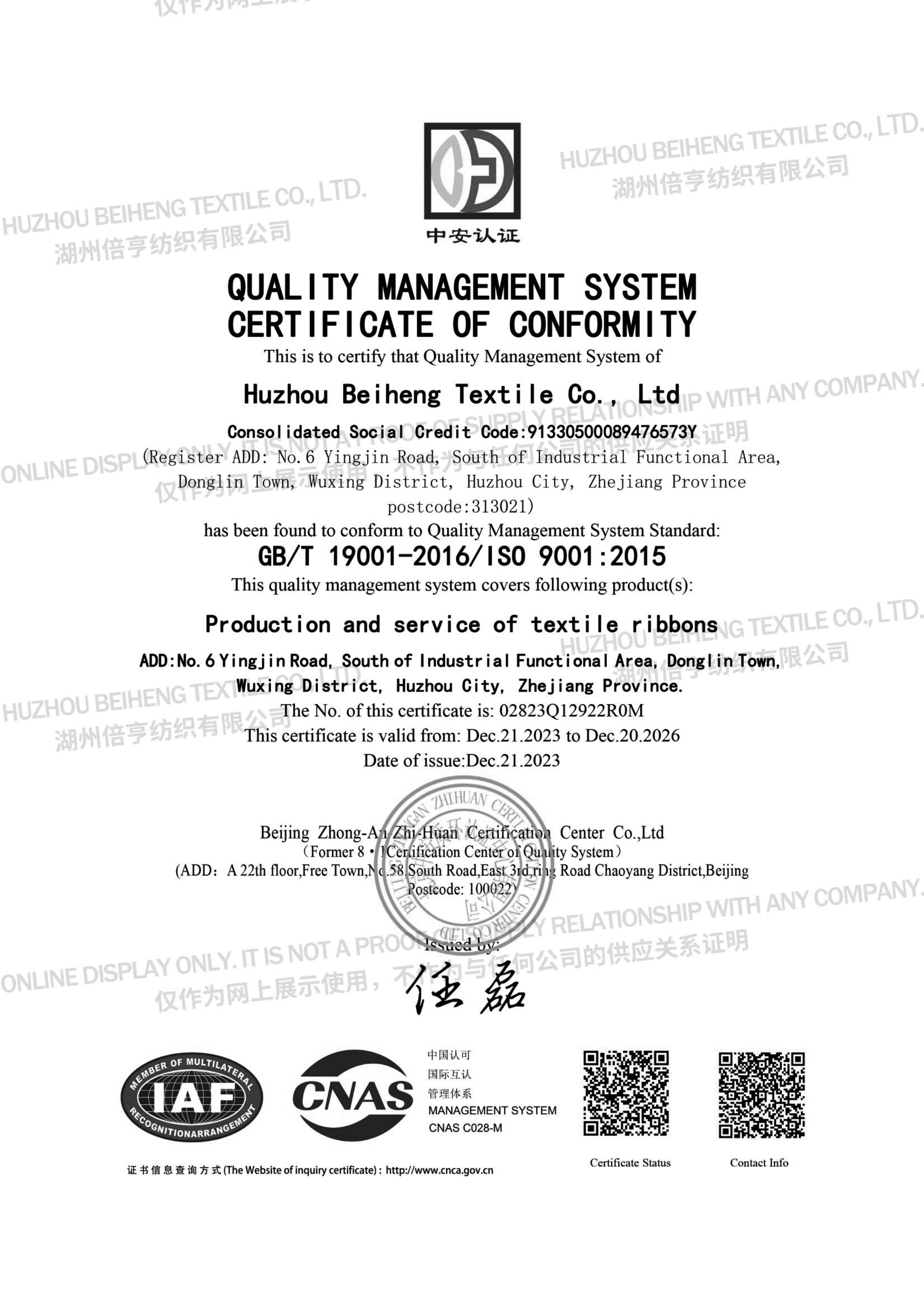
ISO 9001 quality management system certificate 02823Q12922R0M, covering the production and service of textile ribbons.
Have Questions or Need More Details?
Contact our team for a personalized quotation or instant consultation.
Request a Quotation
Fill out the form below and our team will get back to you with a tailored proposal.
WhatsApp Direct Chat
Prefer to chat in real-time? Message us on WhatsApp for instant assistance & quick answers.
- Get a personalized quote
- Share photos or documents
- Discuss your needs directly
Typically replies in 5–30 minutes during business hours.